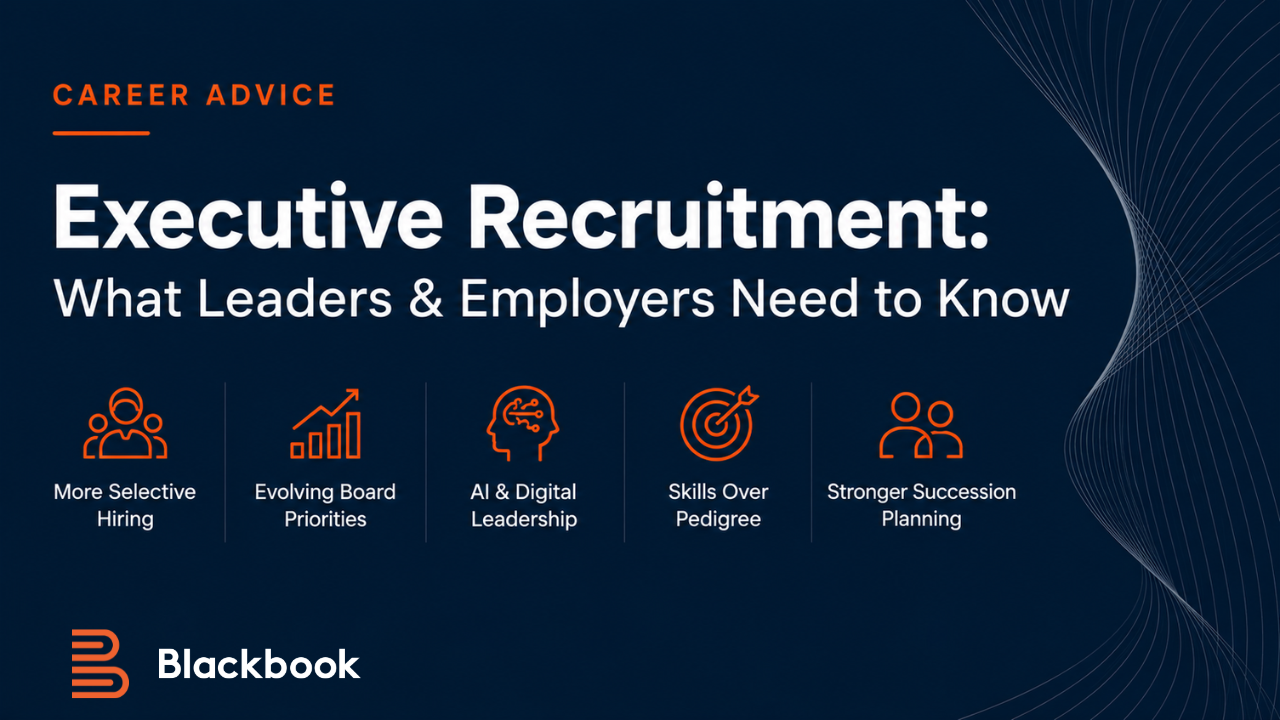
Executive Recruitment Australia: How to Land a Senior Leadership Role
Category: Career Advice | Audience: Senior Leaders & Executives
Navigating executive recruitment in Australia is competitive, nuanced, and relationship-driven. Whether you’re a C-suite leader eyeing your next move or a senior manager stepping into your first executive role, the path to landing the right opportunity rarely follows a straight line and that’s true whether you’re based in Melbourne, Sydney, Brisbane, Perth, or anywhere in between.
At Blackbook Executive, we work with senior leaders across engineering, operations, supply chain, FMCG, industrial, and corporate functions every day, placing exceptional talent through executive recruitment across Australia. Here’s what actually moves the needle.
1. Get clear on what you’re targeting before you start looking
The most common mistake senior candidates make is entering the market without a focused brief. Applying broadly signals uncertainty to hiring managers and recruiters alike.
Before you update your CV or reach out to a recruiter, answer these questions:
- What size and stage of organisation suits you? (ASX-listed, private equity-backed, family-owned, scale-up?)
- What industries energise you and which have you outgrown?
- Are you open to relocation within Australia, or is your current city non-negotiable?
- What does the right role look like in 12 months — not just on paper, but in terms of challenge, autonomy, and impact?
A clear brief makes every conversation with a recruiter or hiring manager more productive. It also signals seniority – leaders who know what they want are leaders worth hiring.
2. Understand how executive recruitment in Australia actually works
Most executive roles particularly those above $200K are never publicly advertised. They’re filled through:
- Retained search assignments given to specialist recruiters
- Direct approaches to passive candidates via LinkedIn or professional networks
- Internal promotions or known referrals
This is true across every major Australian market from the ASX-listed corporates of Sydney’s CBD to the resources and infrastructure sectors in Perth and Queensland, to the manufacturing, FMCG, and industrial hubs in Melbourne, Adelaide, and beyond.
If you’re only applying to advertised roles, you’re competing for a small fraction of what’s actually available. The practical implication: focus as much energy on being findable as on actively searching.
3. Make your LinkedIn profile do the heavy lifting
At the executive level, your LinkedIn profile is your permanent calling card even when you’re not looking. Australia’s executive recruitment community is tight-knit, and your profile is often the first thing a recruiter checks before making contact.
Key things to get right:
- Headline: Don’t just use your current job title. Use a headline that describes what you do and the value you bring. E.g., “General Manager Operations | Driving growth across FMCG and industrial manufacturing”
- About section: Write in first person. Be specific about what you’ve built, led, or transformed not just where you’ve worked.
- Achievements over responsibilities: Each role should lead with outcomes. Revenue grown, costs reduced, teams built, transformations delivered.
- Open to work: If you’re actively looking, turn on the discreet “Open to Work” signal visible only to recruiters not your entire network.
4. Build relationships with specialist executive recruiters
Not all recruitment agencies operate at the executive level, and those that do typically specialise by sector. A generalist recruiter is unlikely to have the board-level relationships needed to place a Chief Financial Officer, a VP of Supply Chain, or a General Manager in FMCG or industrial businesses.
When engaging with executive recruiters:
- Be selective – two or three specialist firms who know your sector well is more effective than broadcasting your details to twenty agencies.
- Be candid – tell them exactly what you want and what you won’t consider. The best recruiters use this to advocate for you behind closed doors.
- Stay in contact – the right role might be six months away. A recruiter who knows you well and trusts you will think of you first.
At Blackbook Executive, we specialise in executive recruitment across Australia with active placements in Melbourne, Sydney, Brisbane, Perth, Adelaide, and beyond. We have deep expertise in FMCG, industrial, engineering, operations, supply chain, procurement, and corporate leadership. The roles we’re briefed on are genuinely relevant to leaders at this stage of their career, wherever you’re based.
5. Sharpen your executive narrative
At the senior level, interviews are less about what you’ve done and more about how you think and lead. Australia’s most discerning hiring panels — whether that’s a board, a CEO, or a PE firm, are looking for three things:
- Strategic clarity: Can you articulate where a business needs to go and how you’d get it there?
- Leadership credibility: How do you build, develop, and retain high-performing teams?
- Commercial acumen: Do you understand the financial levers of a business and how your function drives value?
In sectors like FMCG and industrial, hiring panels will also probe your understanding of category dynamics, margin pressures, operational complexity, and how you’ve led through change in fast-moving or capital-intensive environments. Prepare three to five concise stories that demonstrate each of these qualities drawn from your real experience. Use the STAR format (Situation, Task, Action, Result) but keep it conversational. Executive panels don’t want a rehearsed presentation; they want a leader who can think out loud.
6. Don’t underestimate the reference and reputation piece
At the executive level, references are taken seriously and so is informal reputation. Hiring managers will often ask people in their network about you before a formal process even begins.
This means:
- Stay on good terms with former managers, peers, and board members.
- Be thoughtful about how you exit roles – your last impression is often the most lasting.
- Build a reputation as someone who delivers, develops others, and operates with integrity.
Australia’s senior leadership community is smaller than it looks and this is especially true in industries like FMCG and industrial, where the same networks, customers, and suppliers tend to follow leaders from role to role. People talk. Make sure what they say works in your favour.
7. Be patient but stay visible
Executive searches typically take longer than mid-level hiring. A retained search process can run for three to four months. If you’re actively looking, plan for a runway of six months or more, particularly if you’re targeting a specific type of role or organisation.
During that period, stay visible:
- Comment thoughtfully on LinkedIn discussions in your sector
- Attend industry events and forums relevant to your function in your city and nationally
- Keep your recruiter relationships warm with periodic check-ins
The right executive role is worth waiting for. The leaders who land the best opportunities are usually the ones who’ve invested in their network and reputation long before they needed it.
Ready to explore executive recruitment opportunities across Australia?
Blackbook Executive specialises in senior and executive recruitment across Australia, with active teams in Melbourne and Sydney and a national reach across Brisbane, Perth, Adelaide, and Tasmania. We have deep expertise in FMCG, industrial, engineering, operations, supply chain, procurement, and corporate leadership.
If you’re a senior leader considering your next move whether that’s now or in six months, we’d welcome a confidential conversation.
Get in touch with our team →
Blackbook Executive is a specialist executive recruitment firm with offices in Melbourne and Sydney. We connect exceptional leaders with organisations across Australia where they can make a genuine impact.